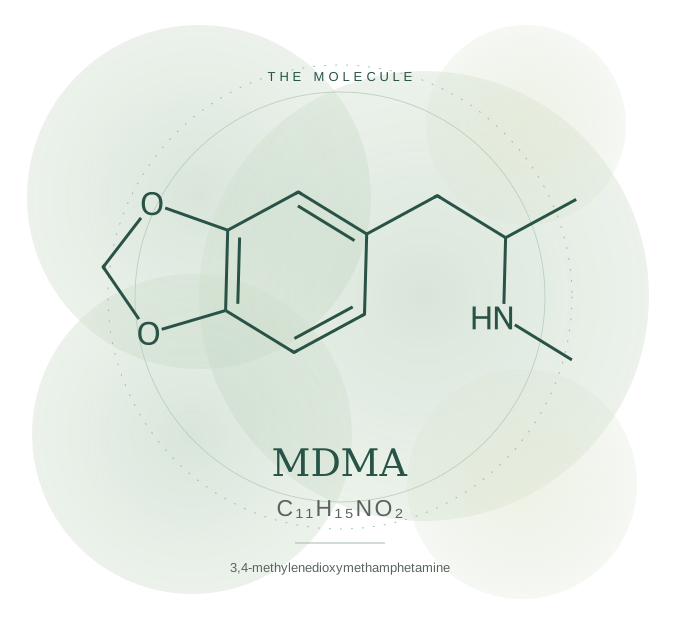
MDMA
Often described as an entactogen or empathogen—a substance that can foster emotional openness, empathy, and a deeper connection with oneself.
Learn about MDMA
The science, the possibilities,
and the risks.
MDMA is a psychoactive substance that can alter mood, energy, and feelings of connection. [1]
Educational overview
Often described as an entactogen or empathogen—a substance that can foster emotional openness, empathy, and a deeper connection with oneself.
Common street names. Products sold under these names may contain other substances; a name does not establish purity. [1]
Brain & body
MDMA affects several chemical messengers involved in mood, alertness, and connection. Their systems interact, shaping both emotional and physical effects. [1]
Helps regulate mood and emotional processing. MDMA increases its availability between nerve cells.
Involved in alertness and the body’s arousal response. Increased activity can raise heart rate and blood pressure.
Involved in reward and motivation. Its effects interact with other messenger systems during the experience.
Involved in social bonding. MDMA can increase blood oxytocin levels; its role in emotional effects is still being studied. [7]
Connecting the effects
MDMA has been found to reduce blood flow in the amygdala—a key brain region involved in fear and threat responses. This may help explain why MDMA can ease anxiety, soften emotional defenses, and reduce hostility. [8]
These effects can make difficult feelings or memories more approachable without leading to panic or overwhelm. Greater openness and reduced anxiety are proposed explanations for therapeutic effects. [2]
Effects may vary. MDMA can also cause temporary anxiety and physical strain. [1]
The clinical research
Researchers are studying why MDMA can make difficult memories more approachable within structured psychotherapy. The mechanisms are still being investigated. The most advanced research has focused on PTSD. [2] [6]
Mitchell et al. · Phase 3 trial · 2023
No longer met PTSD diagnostic criteria at the final assessment, 18 weeks after baseline:
37 of 52 participants assessed
20 of 42 participants assessed
Both groups received three experimental sessions with preparation and integration therapy. These percentages reflect participants assessed at study end, not everyone randomized, and do not establish permanent recovery. [2]
The earlier Phase 3 trial · 2021
The first Phase 3 trial in people with severe PTSD also found greater reductions in PTSD symptoms with MDMA-assisted therapy than with placebo and therapy. [14]
Read the 2021 study ↗Early research
Smaller studies are exploring other possible applications. These findings are preliminary and do not establish MDMA as a treatment for these conditions.
A small study of MDMA-assisted therapy for major depression reported improvements that persisted at follow-up. With only 12 participants and no control group, the findings need confirmation in larger, controlled trials.
Read the study ↗Adults receiving MDMA-assisted therapy had a greater reduction in social anxiety symptoms after 16 weeks than those waiting for treatment. This small study did not compare MDMA with placebo, so it cannot isolate the drug’s contribution from psychotherapy and expectations.
Read the study ↗Researchers have explored MDMA-assisted psychotherapy for anxiety and distress associated with life-threatening illness. This remains an early research area, with larger studies needed to establish whether the approach is effective.
Read the study ↗Risks & medications
Medical history, medications, and the setting all affect risk.
MDMA can raise heart rate, blood pressure, and body temperature. Honesty is important during the screening process to avoid any potential complications. [1]
Temporary anxiety and difficult mood changes may occur. Some people report of low energy and motivation the day after the experience. [1]
Read further
Effects, health risks, and research background.
Mitchell and colleagues, 2023. Original study and outcomes.
Regulatory concerns and reasons for nonapproval.
MAPS’s report of the application resubmission.
A systematic review of psychiatric drug interactions.
Background from the research sponsor and advocacy organization.
Kirkpatrick and colleagues, 2014. Blood oxytocin levels and subjective effects.
David Nutt, Psychopharmacology Institute, 2018. A lecture on MDMA, emotional barriers, and amygdala activity.
Kvam and colleagues, 2026. A 12-participant study without a control group.
Luoma and colleagues, 2026. A 20-participant preprint; the comparison group waited for treatment rather than receiving placebo.
Wolfson and colleagues, 2020. An exploratory randomized pilot study.
Carhart-Harris and colleagues, 2015. A placebo-controlled brain-imaging study in 25 healthy volunteers.
Mithoefer and colleagues, 2011. Journal of Psychopharmacology. A 20-participant study with a two-month controlled follow-up.
Mitchell and colleagues, 2021. A randomized, placebo-controlled trial in people with severe PTSD.
Onset of action and peak timing.
What the designation means for drug development and review.
Educational information, not individual medical advice. Clinical-trial findings do not establish the safety or effectiveness of non-clinical services.
← Back to My Psychedelic Guide